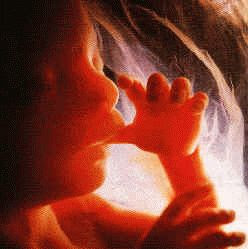
 In discussing abortion and infant death, we invariably come around to asking “What’s going on in the womb?” and “Do babies go to heaven?” While science cannot answer the second question, it can give us some information about the first. Science tells us when the brain is formed, when the heart starts beating, what the baby looks like, and a mother has her own set of experiences to corroborate this (baby’s movement, hiccups, etc).
However, the Bible also informs us of things going on in the womb – things we could not know without Special revelation:
- The baby is designed by God. (Kind of a no-brainer, but some people need to hear this)
For you formed my inward parts; you knitted me together in my mother’s womb. (Ps 139:13) - God plays a part in delivering His children, causing them to trust in Him even as newborns.
Yet you are he who took me from the womb; you made me trust you at my mother’s breasts. (Ps 22:9) - From birth, God is the God of His children. (Because David is giving this as an answer to “You say you trust in God – let’s see God deliver you now!”, I take this phrase to be a bit more than David simply acknowledging that God is the God of all. He’s describing a special connection to God that his enemies do not have)
On you was I cast from my birth, and from my mother’s womb you have been my God. (Ps 22:10) - One can trust/lean (same concept) on God while still in the womb. This is the essence of faith.
Upon you I have leaned from before my birth; you are he who took me from my mother’s womb. My praise is continually of you. (Ps 71:6) - One can be destined for heaven even as a newborn. (Granted, we have to read a bit into David’s statement here, but he seems genuinely relieved that he will one day see his son, so it’s not a stretch to conclude that this prophet of God knew his son was destined for glory)
But now he is dead. Why should I fast? Can I bring him back again? I shall go to him, but he will not return to me.” (2 Sam 12:23) - One can have the Holy Spirit even while in the womb. Speaking of John the Baptist, the angel said:
For he will be great before the Lord. And he must not drink wine or strong drink, and he will be filled with the Holy Spirit, even from his mother’s womb. (Luke 1:15) - One can be emotional and jump for joy while in the womb. (To jump for joy requires not just emotion, but also the ability to communicate [so as to understand what’s going on] and intellect to recognize and respond to what’s going on)
For behold, when the sound of your greeting came to my ears, the baby in my womb leaped for joy. (Luke 1:44)
We’re not told that the actions of these babies were limited to just these 4 people (David, his son, the Messiah and John the Baptist), and we see nothing in the rest of Scripture to say that these can’t be true for any other child of God. So I don’t think there’s harm in concluding that the same can be true for any other child of God. In fact, given these verses, I would say that it takes special effort to conclude that these are not true of other babies as well.
While we all appreciate nice things about babies, we want to also bear in mind that the Bible says ‘not so nice’ things about some babies. Many babies were the subject of divine judgment (Noah’s flood, Sodom & Gomorrah, Joshua’s conquest of Canaan), so I think we’d be rushing it a bit if we said that all babies have faith in God. So which babies do have faith in God? The Bible doesn’t say. I’m content to say that it applies at least to elect babies.
Are Babies Elect?
I emphasize ‘elect babies’, because the Bible has some very uncomfortable things to say about babies with regard to the natural man and wicked people. We can’t ignore these passages:
- What is man, that he can be pure? Or he who is born of a woman, that he can be righteous? (Job 15:14)
- Man who is born of a woman is few of days and full of trouble. … Who can bring a clean thing out of an unclean? There is not one. (Job 14:1-4)
- The wicked are estranged from the womb; they go astray from birth, speaking lies. (Ps 58:3 This is essentially the direct opposite of what David says himself/the Messiah in Ps 22:10, suggesting that, like adults, babies fall into two camps: elect and not elect)
- Behold, I was brought forth in iniquity, and in sin did my mother conceive me. (Ps 51:5 The natural state of man is to be born in sin. Acts 5:12 – and the entire chapter – attests to this.)
- The Lord looks down from heaven on the children of man, to see if there are any who understand, who seek after God. They have all turned aside; together they have become corrupt; there is none who does good, not even one. (Ps 14:2-3. Normally, I might question whether “children of man” is intended to refer to infants. But David’s point could have been made without invoking the word “children”. One wonders why he bothered to mention them.)
- You have never heard, you have never known, from of old your ear has not been opened. For I knew that you would surely deal treacherously, and that from before birth you were called a rebel. (Isa 48:8)
- Then he said, “Oh let not the Lord be angry, and I will speak again but this once. Suppose ten [righteous people] are found there.” He answered, “For the sake of ten I will not destroy it.” (Gen 18:32. In this scene, Abraham is negotiating with God to spare Sodom and Gomorrah. God agrees to spare the cities if He finds 10 righteous people. But one chapter later, we see the Trinity collaborating to rain fire and brimstone on Sodom and Gomorrah (Gen 19:24-25). We know that the cities were large enough to warrant foreign invasion by a federation of foreign kings (Gen 14), so surely it was large enough for there to be were infants around. But because it was destroyed by God, it would seem to me that we need to conclude that God didn’t count the infants as righteous.)
- O daughter of Babylon, doomed to be destroyed, blessed shall he be who repays you with what you have done to us! Blessed shall he be who takes your little ones and dashes them against the rock! (Ps 137:8-9. In this passage, the people of God – by direction of the Holy Spirit – call for God to avenge their blood against their enemies, even to the extent of destroying their infants. This would make no sense if the author/Holy Spirit saw these infants as righteous in God’s eyes.)
- Now go and attack the Amalekites and completely destroy everything they have. Do not spare them. Kill men and women, children and infants, oxen and sheep, camels and donkeys. (1Sam 15:3 There are several other passages like this, where the people of God are commanded to destroy wicked people, including their infants. Deut 20:16-18 is obeyed in Josh 6:17-21; Num 31:17, etc)
I can’t say that I find these passages to be cheery, but they’re in the Bible and they’re part of the discussion, so they have to be mentioned.
Ye Have Heard It Said…
There are a number of passages that are typically put forward as arguments for all infants being saved. I don’t find them compelling:
- He answered, “While the baby was alive, I fasted and wept because I thought, ‘Who knows? The LORD may be gracious to me and let him live.’ But now that he is dead, why should I fast? Can I bring him back again? I’ll go to him, but he will never return to me.” (2Sam 12:22-23 ) The thinking here is that David was comforted in the fact that he would one day see his infant son. Because David believed his son was heaven-bound, we should think all babies are heaven-bound.
But this doesn’t follow. David is talking specifically about his own son, not every infant. Additionally, as a prophet of God, it’s not illogical to believe that he received special revelation from God regarding his son. That doesn’t mean every child will share the same fate (as the previous list of passages demonstrate). - Your little children, whom you said would be plunder, your sons who don’t know good from evil, will enter there. I will give them the land, and they will take possession of it. (Deut 1:39) The thinking here is that since children don’t know good from evil, they’re exempt from the guilt of sin.
The particular passage is about the Israelites rejecting the command to go into Canaan. Because of their disobedience/disbelief, they were punished by wandering in the wilderness for 40 years. Caleb, Joshua and all those under 20 years of age were (eventually) allowed to enter the Promised Land. There are several problems if we try to go this route to support the idea of children going to heaven:
– This necessitates the concept of an “age of accountability”, a doctrine found nowhere in Scriptures.
– This passage is about kids under 20. I sincerely hope that no one in their right mind believes that teenagers don’t know good from evil. Furthermore, later in the same book, parents are commanded to stone rebellious children (Deut 21:18-21). Stoning kids who don’t know good from evil?
– Knowing good from evil is not a sign that one has no sin, it is a sign that one has no knowledge, and that comes with maturity (Heb 5:14). This is true of children and adults.
– Just because you don’t have knowledge of wrong-doing doesn’t mean you’re not culpable (Luke 12:47-48)
– What do we do with the plethora of passages where God destroyed children and/or commanded the destruction of children? (Noah’s Flood, Sodom & Gomorrah, Korah’s Rebellion, Joshua’s Conquest of Canaan, etc) - For God’s wrath is revealed from heaven against all godlessness and unrighteousness of people who by their unrighteousness suppress the truth, since what can be known about God is evident among them, because God has shown it to them. For His invisible attributes, that is, His eternal power and divine nature, have been clearly seen since the creation of the world, being understood through what He has made. As a result, people are without excuse. (Rom 1:18-20) Some people use this passage to say that since infants (and mentally challenged people, savages in the “deepest, darkest jungles of Africa”, etc) have not seen God’s Word, and could not believe – therefore they are not guilty. However, this passage isn’t talking about believing for salvation. It’s talking about seeing nature and realizing that there is a just God who will judge. As Jesus said in Luke 12:47-48, even if they don’t know, they’re still headed for judgment. Ignorance is no excuse for violating God’s moral law.
Babies In Heaven?
Q: How then does an infant get to heaven?
Seems to me that it’s the same as any adult: by grace through faith (Eph 2:8-9). And that faith comes through hearing, and hearing comes through the Word of God (Rom 10:13-17).
Q: How does an infant hear the Word of God?
My response is actually pretty simple: God can and will communicate through a variety of agents: Adults, children, donkeys, stones, angels and the Holy Spirit. Adults and children are (usually) limited so that they can only speak in their own language, but angels and the Holy Spirit are not. They can communicate in any language – even such that a donkey – and surely a baby – can understand. That sounds incredibly bizarre – but how else do we explain the fact that John the Baptist, while still in the womb, knew that Jesus was near? Someone communicated this information to him – an angel or the Holy Spirit (likely the latter). And that same One who told him that Jesus was near, surely has the ability to explain saving faith to this infant such that the infant can believe .. which is essentially what Psalms 22:9-10 says.
It’s an unconventional position to take, but I don’t see anything in the Bible that prevents it from being the case. In fact, I actually see a consistent basis for supporting it.
Thoughts?


Inborn faith aligns with God’s sovereignty – there is no other biblically defendable explanation for womb-based salvation. The bible says that God elected His own before the foundation of the world, at His good pleasure. Said salvation is not based on hearing the gospel, it’s based on God’s sovereign election. God’s hands are never tied…though this creates head scratching curiosities for interpreting other passages of the bible. Hence, we study to show ourselves approved – it all comes together (and it must) for us to be thoroughly finished.
The bible reinforces inborn or elected salvation through teaching that there’s not a single contribution we can make to our salvation that’s acceptable to God. The bible continually teaches that savation is by grace alone, through Christ alone, by faith (trust) alone. Works (e.g. words, actions, thoughts), simply anything the human creature could point to that would merit salvation (in their mind) are struck down repeatedly as null and void in God’s view. God chose us, we didn’t choose God (not of our own choosing – nowhere in the bible is the concept that we naturally seek God). The biblical “womb” examples are but a few of the many grace-based illustrations that support said beliefs.
The question that pops up (though I don’t know if there’s a good answer) is when do His elect become aware that they are saved? Some receive said insight in the womb (so says the bible), others at a very young, others perhaps in the last moments of their lives. This is not an easy one to clearly undestand.
Thanks, TPeters.
Don’t forget that the response of faith/belief is a condition/requirement for salvation:
[+]Then he brought them out and said, “Sirs, what must I do to be saved?” And they said, “Believe in the Lord Jesus, and you will be saved, you and your household.” (Acts 16:30-31)
[+]Because, if you confess with your mouth that Jesus is Lord and believe in your heart that God raised him from the dead, you will be saved. For with the heart one believes and is justified, and with the mouth one confesses and is saved. (Rom 10:9-10)
If we abide till the end, we will be saved. If we wither and do not abide, we will be cut off and thrown to the fire (Jn 15), a sign that we were never true believers to begin with (1 Jn 2:19)
After reading your response, I’m inclined not to agree with the aspects you mentioned as conditions for salvation. As evidences for salvation, yes, but as conditions for salvation? No.
Here’s what I see in the bible regarding our salvation and justification – the trinity plays three roles. 1) God the father purposed the salvation for his elect, at his good pleasure. #1 is an act of grace. 2) Jesus the son secured the salvation of God’s chosen by fully atoning for their sins on the cross with his blood and in doing so fully appeased God’s wrath. 3) The Holy Spirit regenerates the “dead” sinner and not in response to any contribution of “works” or aspect of merit (e.g. words, thoughts, feelings, the sinner’s prayer…anything the individual could point to as “their part” and in doing so create grounds for boasting). By possessing the Holy Spirit, and only by possessing the Holy Spirit is trust or “faith” in Christ enabled. To that point, the source of saving faith in the bible is ALWAYS the result of supernaturally provided faith (it is not inherent to the human creature, at least based on how I interpret the bible).
The bible says the timing of #1 happened before the foundation of the world. #2 happened at the cross. The timing of #3 is only known by God the father and the Holy Spirit.
Where I’m heading with all of this – I’m fairly confident that you and I agree on all of the points #1 and #2 above. Where we may not agree appears to be the timing of regeneration. Simply, we don’t know when the Holy Spirit regenerates God the father’s chosen. Obviously this must happen in advance of us demonstrating regeneration by submitting to God’s directives and repenting of our sins, but as to when regeneration actually occurs for anyone, I can’t say. Regeneration proceeds and must proceed any “I’m saved” actions shown by God’s chosen. Until that point we’re dead in our sins and incapable of seeking God (nowhere in the bible is the concept, let alone the teaching that we naturally seek God).
In Luke 1:44, it appears to me that the baby who jumped for joy in the womb was already regenerated. How else would he (i.e. his spirit) have rejoiced in the womb? Another example of spiritual regeneration proceeding human action was the resurrection of Lazarus. Lazarus was dead, as in “stinking” dead. When Jesus commanded him to come forth, Lazarus was made alive again first, then, came out as commanded. To be clear, Lazarus was not offered the gift of regeneration. Lazarus was simply regenerated as an aspect of God’s grace and Lazarus “will” had nothing to do with it.
My point – we don’t know the timing of God’s spiritual regeneration in any of us, but we do know that “it” (regeneration that leads to our glorification) happens every time without fail, at the appointed time, for God the father’s chosen. Consequently, I absolutely believe that infants, including unborn infants, can be regenerated prior to leaving their mother’s womb. For most others, it’s probably later in life (only God knows, and that is the point…from my standpoint).
In your estimation, is it possible for a person to be regenerated but not believe for some time? For example, do you believe JTBaptist was regenerated in the womb (which I believe was the case), but that he didn’t come to have saving faith / personal belief until some time much later (~12 years old or whatever)?
I believe the two events are either simultaneous or near-simultaneous: the instant a person is born again, he starts believing. John ch 3 doesn’t give a time reference from the time a person is born again (v8) and the time a person starts believing (v15).
I also believe the inverse is true: I believe that the instant a person gets a sin nature, he starts sinning (by not loving the Lord his God with all his heart, soul, mind and strength). Even in the womb.
This is a challenging subject to reconcile, at least for me. On one hand I believe in total inability (total depravity), the bible speaks so clearly on this topic. On the other hand, because God’s own are saved by grace and were chosen before the foundation of the world, I also believe that God’s elect can have their lives extinguished as infants and even in the womb. God’s purpose in salvation cannot be thwarted by human inability or earthly calamities. That’s not to say that all infants, either born or unborn, are “saved” or were intended to be saved. Ditto for the many adults who’ve repeated “the sinners prayer”, including those who’ve done miracles in Jesus name and claimed to believe – the sermon on the mount in the book of Matthew makes that quite clear. My point is that salvation is God’s doing, all of it, and his purpose in salvation cannot be thwarted.
Speaking personally, I was well into my adult years before I realized that I was saved by an act of grace. I have no doubts that the holy spirit was in within me before I realized that I was saved by grace. It was just later in life that I morphed from “milk” to “meat” regarding the word of God. My belief (trust) had nothing to do with me – it had everything to do with God.
As for sinning, or, being a “sinner”, no one of can reach the goal of not ever sinning in this lifetime, even after regeneration. What we can do is thank God for Jesus’ atoning work on the cross that made us sinless in the eyes of God the father. Unredeemed sinners are the ones bound for hell. Redeemed sinners, God’s elect, those for whom Jesus died, are justified in spite of their (our) sins – now and later…not that any of us are happy that we still do things wrong in God’s eyes.
So, coming full circle, yes, I do believe that the events of being regenerated and believing can happen at different times. The former MUST happen for salvation. The latter (consciously believing) WILL happen unless that person’s life gets snuffed out before said event. Again, I’m still working my way through all of this…as I keep reading God’s word and realizing how little I truly understand and know 🙂